
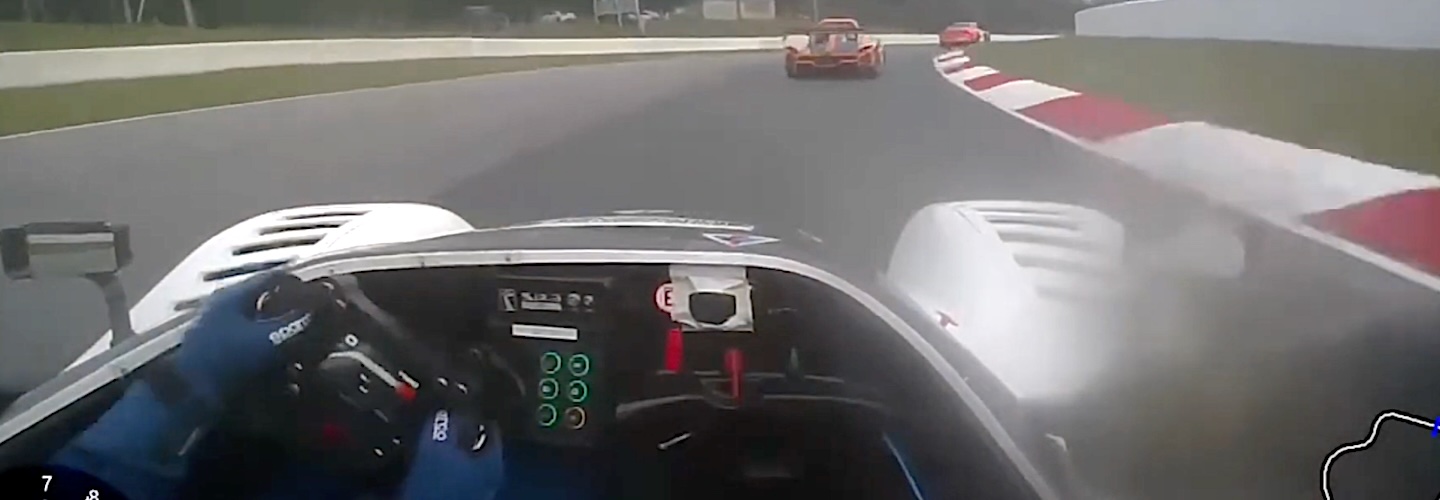
In motorsport, performance begins with vision in the most literal sense. Where a driver looks influences where the car goes. A driver who looks further ahead is generally smoother, faster, and more controlled.
The same principle applies to organizations and the leaders who guide them.
Where leaders direct their attention shapes how the organization responds. Leaders who focus only on immediate demands are forced to react to every disruption. Leaders who maintain a longer line of sight can anticipate change, recognize emerging risks, and make smaller, more deliberate corrections before instability takes hold.
Vision does not eliminate uncertainty. It helps leaders navigate through it.
Looking Up vs. Looking Down
When a driver fixates on the tarmac just beyond the front bumper, every bump and movement demands a reaction. The hands grow busy, the car becomes unsettled, and speed is lost. The driver is managing the moment rather than driving the race.
Organizations can operate the same way.
Their attention remains fixed on today's operations, next week's targets, the latest customer issue, or the next internal crisis. Decisions become reactive. Energy is spent correcting problems rather than advancing a deliberate direction.
By the time an obstacle becomes impossible to ignore, such as a market shift, cultural fracture, loss of customer confidence, or operational failure, the organization may have little room left to respond. Large and abrupt corrections are required, often unsettling the very people, systems, and relationships needed to recover.
When drivers lift their eyes and look further ahead, the car begins to settle. Their inputs become smaller, calmer, and more deliberate. They see the corner before reaching it and begin preparing for how they will enter, navigate, and exit.
Effective leaders operate in much the same way. They look beyond immediate activity, connect emerging signals, and prepare the organization for change before change is forced upon it.
Seeing Through the Corner
Every racer learns an important lesson early: look through the corner, not at it.
The secret to speed is not simply reacting faster. It is seeing further.
Turn 2 at Canadian Tire Motorsport Park, commonly known as Mosport, provides a powerful example. At the top of the hill, the track drops away and the driver cannot immediately see where it leads. The apex is hidden beyond the crest, so the driver must use the left-hand wall and surrounding reference points to establish the intended line until the corner comes fully into view.
You have to envision the line before you can see it clearly. You have to trust that the track is there and remain committed to where you intend to go.
The same is true in leadership.
Strategic vision is not a slogan on a wall or a paragraph in a planning document. It is the disciplined practice of keeping attention on purpose, positioning, and long-term direction, even when the immediate path is uncertain.
A clear vision gives shape to decision-making. It creates a shared understanding of the future the organization is working toward. It gives people a reference point during turbulence and helps leaders avoid abandoning direction every time conditions become uncomfortable.
However, vision alone is not strategy.
Vision describes the future an organization is trying to create. Strategy determines the distinctive path it will take, including where it will compete, how it will create value, and what it will choose not to do. Execution translates those choices into priorities, accountabilities, and action.
Leaders must see through the corner, but they must also choose the line.
When Competition Is in Sight
There is another truth racers understand deeply: what you focus on, you tend to follow.
When a driver is chasing another car and fixates on its rear bumper, the field of vision narrows. The following driver begins reacting to every move the lead car makes, mirroring its line and, potentially, its mistakes. If the car ahead runs off track, the following driver may be drawn into the same error.
Experienced drivers know better.
Competitor awareness is important. Competitor fixation is dangerous.
They remain aware of the car ahead, but their vision extends beyond it, through the corner and toward their own intended line. The competitor is a reference point, not the destination. Only when the leading car changes direction, brakes unexpectedly, makes a mistake, or attempts a defensive block does the following driver briefly refocus to assess and respond.
The parallel to strategy is significant.
When organizations become overly focused on competitors, they begin to lose their own line. They copy visible initiatives, adopt the same language, pursue the same customers, and gradually become less distinguishable from everyone else in the market.
Competitor awareness is important. Competitor fixation is dangerous.
Strategy requires an organization to understand competitors without allowing competitors to define its choices. The goal is not simply to run the same race faster. It is to establish a distinctive position, supported by activities and trade-offs that competitors cannot easily replicate.
Visionary leaders acknowledge competition, but they do not allow it to determine their direction. They remain focused on the value their organization is uniquely positioned to create and the strategic choices required to sustain that position.
When Conditions Get Slippery
Driving in the rain separates good drivers from great ones.
Grip becomes uncertain. Visibility is reduced. Reflections distort depth. Traction changes from one corner to the next. Inputs must become softer, more measured, and more deliberate.
In those conditions, vision becomes even more important.
When drivers focus only on the road immediately ahead, they may recognize a slide only after it has already developed. Looking farther down the track makes subtle changes in movement easier to detect, allowing earlier and gentler corrections.
The difference is whether you react after control has been lost or correcting while the car is still composed.
Leadership follows the same pattern.
When markets shift, culture weakens, confidence fades, or operational pressures increase, leaders who focus only on immediate activity often recognize instability too late. Their reactions become large, emotional, and disruptive.
Leaders with a longer line of sight can detect drift earlier. They notice changes in customer behaviour, employee confidence, decision quality, collaboration, and organizational energy before those changes become a crisis. They can make smaller corrections that preserve trust, traction, and momentum.
Culture plays a critical role in this process.
In a healthy culture, people raise concerns early, test assumptions, and identify emerging risks before they become unmanageable. In a fearful or overly hierarchical culture, warning signs are often suppressed. Employees learn to remain quiet, protect themselves, or wait for senior leadership to notice what is already evident elsewhere in the organization.
By the time the issue reaches the leadership team, the organization may require a much larger and more disruptive intervention.
Culture determines whether the organization can sense and respond to drift while it still has room to manoeuvre.
The Vision-to-Execution Line
The fastest lap is not achieved through brute force. It is achieved through coordination between the driver's eyes, hands, feet, tires, car, and track.
Each input is guided by what the driver sees ahead.
Organizations require the same coordination.
Vision connects to strategy. Strategy establishes priorities and trade-offs. Priorities determine where resources, leadership attention, and organizational energy are committed. Execution turns those commitments into action. Measurement and learning reveal whether the organization is holding its line or needs to adjust.
When that line of sight is broken, teams lose flow. Departments pursue conflicting priorities. Resources are spread across too many initiatives. Decisions become inconsistent. Culture fractures under pressure.
A leader may have a clear view of the future while the rest of the organization remains uncertain about where it is going or how it is expected to get there.
Vision becomes organizationally useful only when people understand the future the organization is working toward, the strategic choices being made, the priorities that follow from those choices, the role they play in moving the organization forward, and the opportunities or distractions the organization will decline.
When people understand the long-term direction, strategic priorities, and boundaries for decision-making, they can make better choices without waiting for constant instruction. They can self-correct in alignment as conditions change.
This is where vision begins to influence execution.
Holding the Line Without Becoming Rigid
The best drivers understand that vision requires trust.
They trust their preparation, their reference points, the car, and the line they have chosen. They resist the temptation to make sudden corrections every time the car moves beneath them.
Leaders require the same discipline.
If the organization has done the work to understand its environment, establish a clear position, build leadership alignment, and strengthen its culture, it should not need to change direction with every new pressure or competitor move.
Holding the line, however, does not mean ignoring evidence or refusing to adapt.
A driver who remains committed to the wrong line will eventually leave the track. An organization that refuses to question its assumptions can remain disciplined and still be wrong.
Strategic patience means staying committed to a deliberate direction while continuing to test the assumptions on which it was built. It means distinguishing between temporary turbulence and evidence that conditions have fundamentally changed.
The challenge is to make deliberate adjustments without abandoning strategic direction every time uncertainty appears.
When leaders lose perspective, urgency can quickly become panic. Panic often produces overcorrection, creating more instability than the original problem.
The organization does not need to be perfectly still. It needs to remain composed.
Where Leaders Should Look
Strategic vision is ultimately a leadership discipline. It requires leaders to divide their attention between the present and the future without becoming consumed by either.
Leaders should regularly ask:
- What changes are emerging beyond our current planning horizon?
- Which assumptions are we continuing to rely on?
- Are competitors influencing our choices more than customers, purpose, and positioning?
- Where are we seeing early signs of strategic, operational, or cultural drift?
- Can people across the organization explain where we are going and why?
- Are our priorities and resource decisions consistent with the future we say we want to create?
These questions help leaders lift their eyes from immediate activity without losing touch with operational reality.
The purpose of vision is not to predict every turn. It is to give the organization enough direction to navigate the turns it cannot yet see.
Seeing Beyond the Bumper
Seeing beyond the bumper means more than looking further ahead.
It means leading with clarity rather than fear. It means understanding immediate pressures without allowing those pressures to consume the organization's attention. It means acknowledging competitors without following them blindly. It means detecting drift early and making measured corrections before instability becomes a crisis.
Most importantly, it means connecting the future the organization wants to create with the strategic choices, cultural conditions, and implementation discipline required to move toward it.
In racing, vision helps pull the car through the corner.
In leadership, vision helps pull people toward possibility.
So, ask yourself: where are you looking?
At the problem immediately in front of you?
At your competitor's next move?
Or through the corner, toward the future your organization has deliberately chosen to create?